|

Journal
Writing
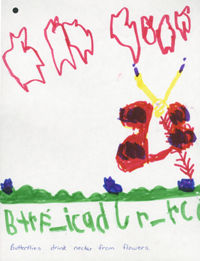
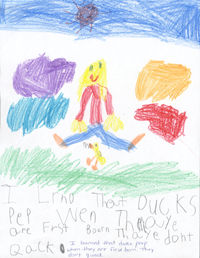
Journal writing is a special time for us to write about what is important in our lives. As the teacher, I model writing for the students daily. During our journal time, I choose a topic, draw a picture on the chalkboard or in my journal, and write words to go with my picture. As I write, I use a variety of techniques that I want the students to use. Some words I will spell correctly from memory. Others, I stretch out (in "turtle talk" - slowly like a turtle would speak, if he could!) and encourage the students to name the letters they hear. Some days we only listen for the beginning sound, other days we see how many sounds we can hear. I will also ask children where we can look in the room if we want to know how to spell certain words (such as names and color words). Through my modeling, the students learn to use these techniques in their writing. Eventually we will discuss the use of capital versus lowercase letters, spaces between words, and punctuation marks. It is important to remember that children are at all stages of development and it shows in their writing. Following my writing sample, the students get out their spiral notebooks and "write" for journal time (we begin this the very first week of school). When we start, I define "writing" for the students as pictures only, scribble writing, random letters, beginning sounds, all sounds they can hear or conventional spelling (I model each of these and describe that some kids write in each of these ways and I think all are OK.) The students write the date on each page and use crayons or colored pencils to make a picture and write letters if they are ready. When they finish, the students "read" their writing to me --sometimes I write the words below theirs with a pencil (in tiny printing), using conventional spelling. I do this mainly to help adults who want to read the journal later. We have a "journal sharing time" as well, when willing volunteers share what they have written with their classmates. As the year progresses, I expect more advanced writing from the students. I individualize these expectations based on a student's current level of achievement. First I will require at least one letter, then a few letters, then a few words (spelled in kindergarten writing) before they can read their journal to me. Every year my students have loved journal time, and it is so much fun to see the progress they have made at the end of the school year! When you come to visit our classroom--please ask your child to show you his/her journal. You will be so proud of the progress he/she has made in kindergarten this year!
The stages of writing are as follows: 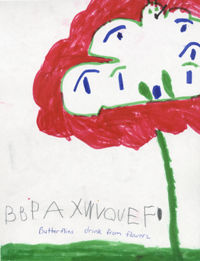 The earliest stage of emergent writing is drawing. In Stage 1, the child emphasizes the initial consonant of a word (such as the g in grass) and writes the letter G. 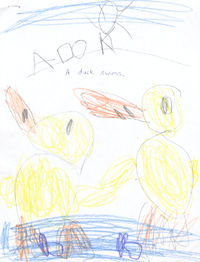 Precommunicative This child knows that
writng conveys a
message and uses a string of letters to approximate a
sentence. In Stage 2, the child emphasizes the initial and final consonants (such as g and s in grass) and writes GS.
In Stage 3, the child emphasizes initial, final, and interior consonants (such as g, r, and s in grass) and writes GRS 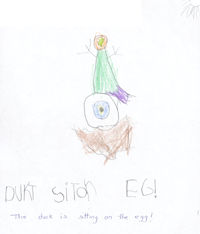 Phonetic This child correctly
spells high frequency
words and begins to use punctuation marks. In Stage 4, the child emphasizes initial, final, and interior consonants, and the vowel place holder (the vowel may be incorrect, but it is in the correct position) and writes GRES
Approximate spelling of
several sentences In Stage 5, the child uses the full spelling of the word, with final components from visual memory systems and better vowel discrimination and writes GRASS. Home
|